Troughs and Downspouts Both Cleared

Gutter Cleaning in Sandy Springs, GA

Sandy Springs gives your gutters two debris seasons a year instead of one, and clay soil at the foundation punishes any overflow that results. We hand-clear the troughs, flush every downspout until water actually exits the bottom, and tell you if the problem is debris or something a cleaning will not fix.

Gutter cleaning with a pressure washer in Sandy Springs, GA

Two Debris Seasons, Not One

Most homeowners think of gutter cleaning as a fall chore. In this part of Georgia that assumption leaves your gutters packed for half the year.

The first load arrives in spring. Oak is the dominant pollen tree across metro Atlanta, and counts climb from late March into mid-April before easing off toward the end of May. What lands in your gutters is not just the yellow dust that coats cars. It is the physical debris that comes with it: spent oak catkins, maple samaras, seed pods, and small twigs. Catkins in particular are the worst thing that goes into a gutter, because they are stringy, they mat into a dense felt, and they pack a downspout elbow more effectively than leaves do.

The second load is the one everyone expects. Hardwood leaf drop in Sandy Springs runs from October well into December, and a single mature oak or hickory over the roofline can fill a run of gutter in a couple of weeks.

Skip the spring cleaning and the catkin mat sits in the trough all summer, holding water, breeding mosquitoes, and rotting into a soil-like sludge that the fall leaves land on top of. By December you are not clearing leaves anymore, you are excavating.

What Overflow Does on Clay Soil

The reason clogged gutters matter more here than in a lot of the country comes down to what is under your house. Sandy Springs sits on Piedmont clay, and clay behaves differently from sand or loam when you dump water on it.

Clay does not absorb quickly. Water coming over the lip of a blocked gutter hits the ground in a concentrated line along the foundation and sits there instead of soaking away. Two things follow. First, the soil right against your foundation wall goes through repeated swelling and shrinking cycles as it saturates and dries, and that movement is a well-known driver of foundation stress. Second, saturated soil against a basement or crawlspace wall creates hydrostatic pressure that pushes water toward any crack or joint it can find.

The visible symptoms show up long before anyone connects them to the gutters:

Fixing the gutter is the cheap end of that chain. Waiting until it is a foundation or fascia conversation is not.

Why Some Gutters Still Overflow After a Cleaning

This is the call we get most often, and it is worth explaining because it saves people from paying for a second cleaning that will not help.

Pitch. Gutters are not level. They need roughly a quarter inch of fall over every ten feet of run so water actually travels toward the downspout. Hangers loosen, fascia softens, and a section that was pitched correctly at install can flatten out or even reverse over the years. A gutter holding standing water an hour after the rain stops has a pitch problem, not a debris problem.

Capacity. Standard five-inch K-style gutter with a 2x3 downspout handles ordinary rain fine. A steep roof plane feeding a long run during the kind of intense summer downpour this region gets can simply deliver more water per minute than that profile can carry. The fix is a larger six-inch trough, a 3x4 downspout, or an additional downspout, not more cleaning.

Underground drain lines. Plenty of homes here have downspouts tied into buried pipe that carries water to the street or a daylight outlet. Those lines silt up, collapse, or fill with roots, and when they do, the water backs up the downspout and out the top. If we flush a downspout and the water will not go anywhere, that is what we are looking at.

We will tell you which of these you have. If it is not something a cleaning solves, you should know that before you write a check.
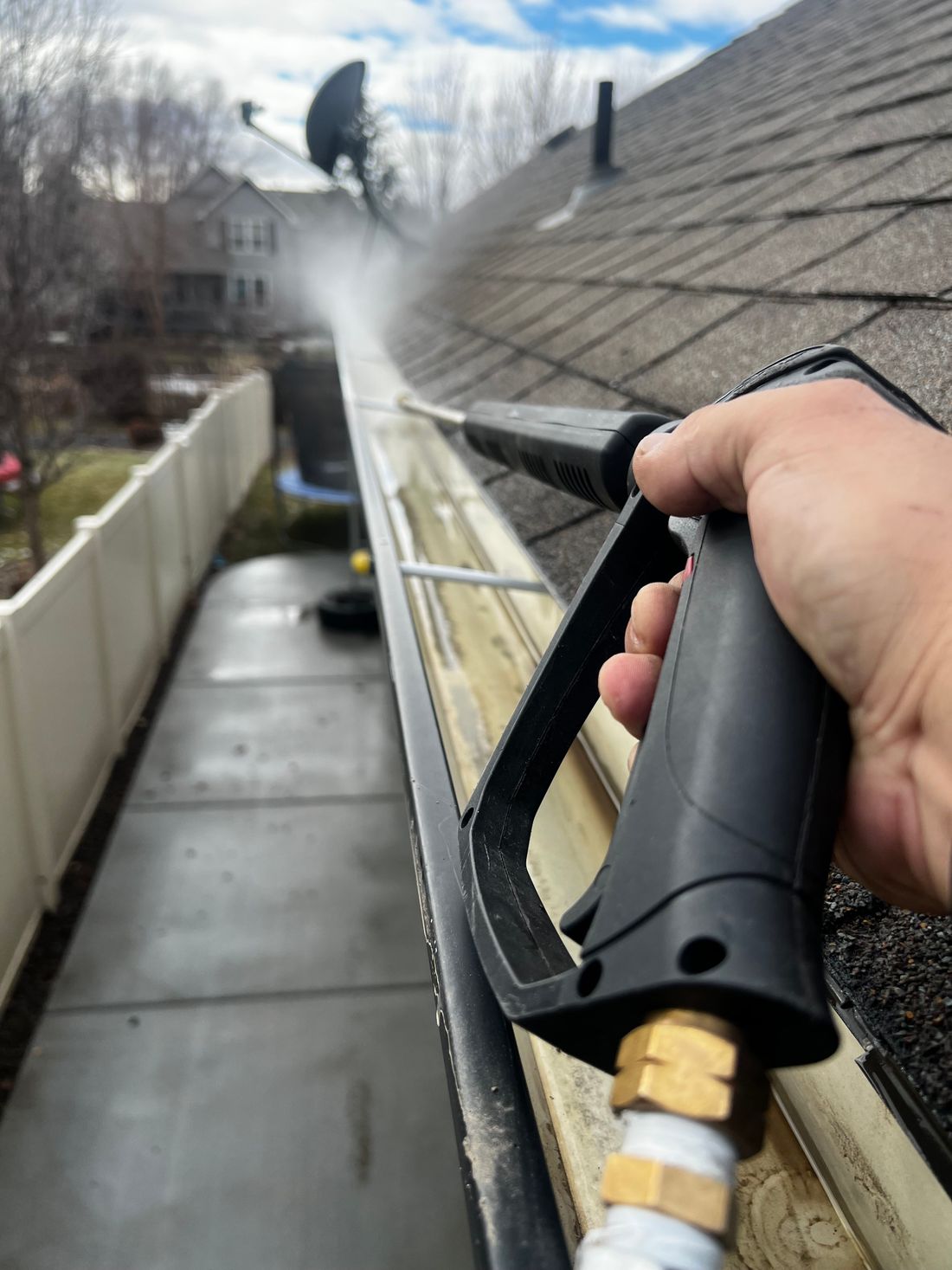
How We Actually Do It

Hand-clearing first, water second. We remove the bulk debris by hand into a bucket rather than flushing it down the system, because washing a season of packed catkins into a downspout is how a clear gutter becomes a clogged one two feet lower.

Then we flush each run from the far end toward the downspout and watch the outlet at ground level. If water is not coming out the bottom at the rate it is going in the top, we stop and find out why rather than declaring the job done.

We bag the debris and take it with us, rinse any splatter off the siding and windows below the work area, and walk the perimeter with you at the end. If we saw loose hangers, a soft fascia board, a separated seam, or a downspout that is not draining, you hear about it then, with the specific location, not as a vague upsell.

What Gutter Cleaning Costs in Sandy Springs

In the Atlanta market, gutter cleaning generally runs about $0.75 to $3.00 per linear foot, with most homeowners landing somewhere between $102 and $174 and an average close to $134. Single-story homes sit at the low end of that per-foot range, roughly $0.50 to $2.00, while two-story work runs about $1.00 to $3.00 because of the added ladder time and safety setup. Most homes in this area carry between 125 and 200 linear feet of gutter.

What moves your number within that range:

If you are already scheduling a house wash or roof soft wash, bundling the gutter clearing into the same visit costs less than booking it separately, since the setup is already on site.

Frequently Asked Questions

How often do gutters need cleaning in Sandy Springs?

Twice a year for most properties here, because this area produces two separate debris loads rather than one. Oak catkins and seed pods come down from late March through May, and hardwood leaf drop runs from October into December. A house with little tree cover can stretch to once a year, but a lot in the middle of mature canopy sometimes needs a third visit.

My gutters were just cleaned and they still overflow. Why?

Overflow that continues after a clearing is almost always pitch, capacity, or a blocked underground line rather than debris. Gutters need roughly a quarter inch of fall for every ten feet of run, and hangers loosen over time. Five-inch gutters on a steep roof with a large drainage area can also simply be undersized for a hard Georgia downpour.

Do you clean the downspouts as well as the troughs?

Yes. Clearing the trough and leaving the downspout packed just moves the clog somewhere you cannot see it. We flush every downspout and confirm water is exiting the bottom, and we tell you if the flow suggests a blockage in an underground drain line past the elbow.

Are gutter guards worth it in this area?

They help with whole leaves and they are genuinely useful under heavy hardwood cover. They do less against oak catkins, pine needles, and shingle grit, which are small enough to pass through or mat on top of most screens. Treat guards as something that stretches the interval between cleanings, not something that ends them.

Get Your Gutters Cleared Before the Next Storm

Call for a firm price. We will tell you honestly whether cleaning is what you need.

Call (770) 651-7707